



Article by
Antonios Adema
Parksville resident, Chartered Professional Accountant (CPA) and cyclist. Article written with AI assistance and has not been facted checked. Contact Tony if you have any particular concerns as they relate to your situation.
Imagine it’s two weeks before your Annual General Meeting and you’re staring at a shoebox overflowing with crumpled receipts and mismatched ledgers. You know the board expects clarity, but the distinction between basic accounting records and formal financial statements often feels like a moving target. It’s a common source of anxiety for many of the 29,000 non-profit organizations across British Columbia trying to stay compliant with BC Society Act financial reporting requirements. Being a treasurer is a vital role, yet the fear of legal repercussions or simple clerical errors can make the position feel overwhelming.
We understand that you want to provide transparency to your members without spending every weekend buried in spreadsheets. This guide is designed to help you master the complexities of the legislation through a practical, step-by-step approach to compliance. We’ll provide a clear checklist of reporting requirements and an organized system for tracking funds, so you can head into your next AGM with total peace of mind.
Key Takeaways
- Gain clarity on how the BC Societies Act governs your organization and why mandatory reporting is essential for maintaining legal compliance.
- Learn to distinguish between daily accounting records and the formal financial statements needed to provide members with a clear picture of society funds.
- Identify your society’s specific status to understand exactly which disclosure requirements apply to your board, members, and employees.
- Adopt practical best practices, such as monthly reconciliations, to reduce the time spent on year-end tasks and ensure a smooth AGM.
- Discover how professional support can streamline BC society act financial reporting by organizing messy ledgers into precise, compliant documents.
Understanding Financial Reporting Under the BC Societies Act
The BC Societies Act isn’t just a set of dry rules; it’s the foundation of accountability for the over 29,000 non-profit organizations in our province. Whether your group is a small local sports club in Parksville or a large provincial health initiative, following the guidelines for BC society act financial reporting is a legal requirement. These rules ensure that every dollar collected from members or donors is tracked with precision. This transparency allows members to realize exactly how funds are being utilized to support the society’s mission. Compliance is not optional. Failing to meet these standards can lead to a society being struck from the provincial registry, which effectively ends its legal existence and its ability to hold assets.
The Role of the Society Treasurer
Being a treasurer is often a volunteer position, but it carries significant weight. You’re responsible for maintaining accurate accounting records that reflect the society’s financial health at any given moment. This involves more than just keeping receipts; it’s about building a narrative of fiscal responsibility for the board. Before the Annual General Meeting (AGM) arrives, the treasurer must ensure all data is compiled into formal reports. Understanding Financial Statements is the first step in this process, as these documents summarize the raw data into a format members can easily digest. The treasurer also acts as the vital link between the society and professional accounting services, ensuring that specialized knowledge is applied to the organization’s unique needs without the board feeling overwhelmed by technical details.
Key Compliance Deadlines to Remember
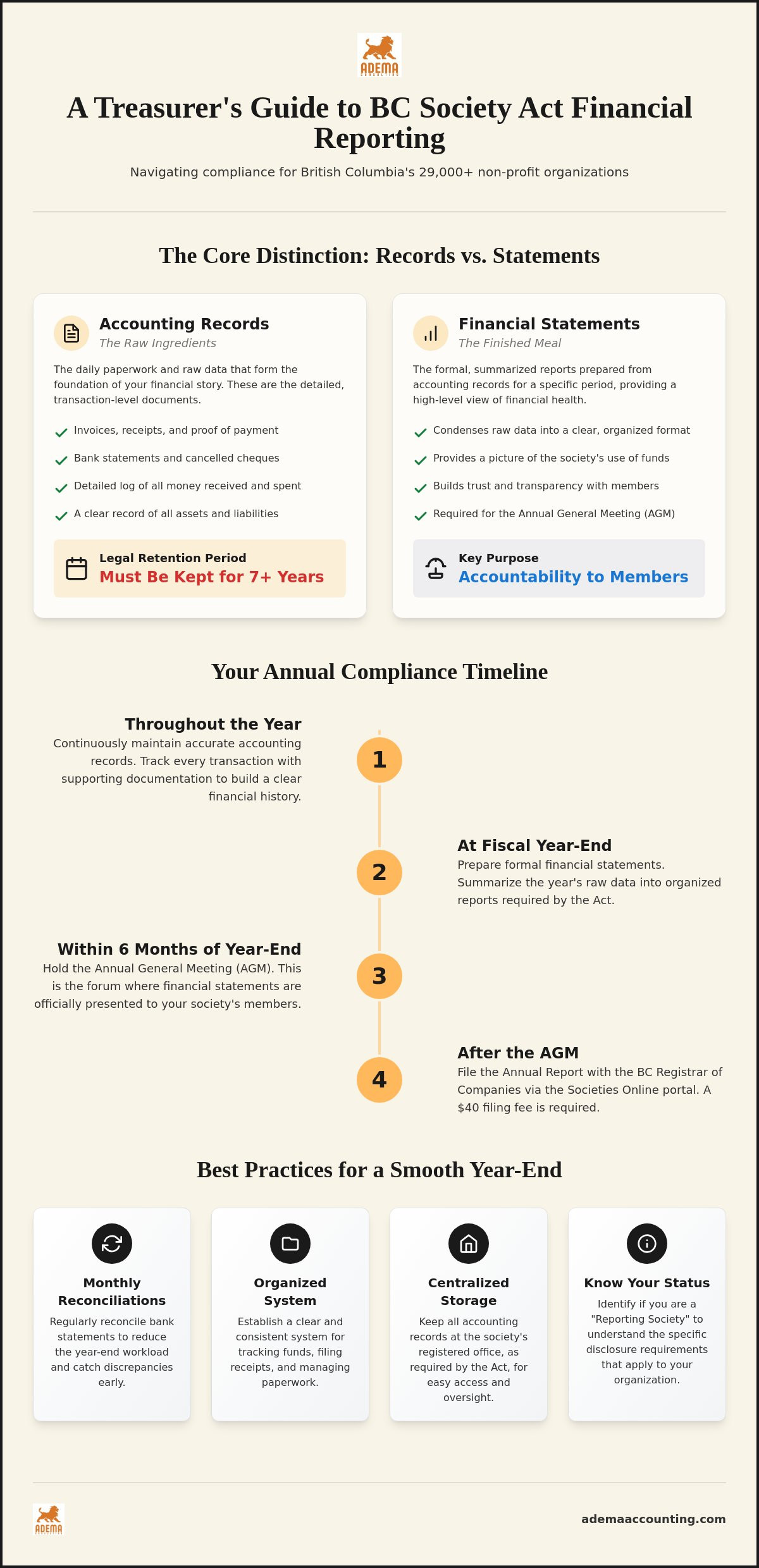
Staying on the right side of the law requires a keen eye on the calendar. Under the Act, financial statements must be prepared at least once every fiscal year. These reports don’t just sit in a drawer; they must be presented to your members at the AGM. In British Columbia, this meeting typically must occur within six months of your society’s fiscal year-end. Once the members have reviewed the reports, the final step is filing an annual report with the BC Registrar of Companies. This is done through the Societies Online portal and currently requires a $40.00 filing fee. Keeping these dates organized prevents the stress of last-minute scrambles and ensures your organization remains in good standing with the province.
Accounting Records vs. Financial Statements: What the Law Requires
One of the most frequent points of confusion for new treasurers is the distinction between daily paperwork and the final reports presented at the AGM. Think of accounting records as the raw ingredients of your financial story. These include every invoice, receipt, cancelled cheque, and bank statement your society generates. Financial statements, on the other hand, are the finished meal. They take that mountain of raw data and condense it into a clear, organized format for a specific period. Both are essential components of BC society act financial reporting, but they serve different purposes in the eyes of the law.
The Act is very specific regarding how these documents must be handled and stored. You are legally required to keep all accounting records for at least seven years. This retention period ensures that the society can provide historical transparency if questions arise about past funds or tax filings. These records must be kept at the society’s registered office or another location determined by the directors. Having a centralized, known location for these files is vital for maintaining organized control and ensuring that the board can fulfill its oversight duties without unnecessary delay.
What Constitutes Valid Accounting Records?
To stay compliant, your records must provide a complete picture of the society’s financial life. This includes a detailed log of all money received and spent, along with the specific purpose for each transaction. You must also maintain a clear record of the society’s assets and liabilities, including any outstanding debts or long-term obligations. Documentation is required for every single transaction. Whether it’s a small petty cash reimbursement for office supplies or a significant provincial grant, you must have the underlying paperwork to prove where the money went. Following these legal rules for non-profit finances protects the society from accusations of mismanagement and builds trust with your membership.
Standard Components of Society Financial Statements
When you prepare your annual reports, they must contain specific elements to meet provincial standards. Most societies will need to present the following:
- Statement of Financial Position: Often called a balance sheet, this shows what the society owns and what it owes at a specific point in time.
- Statement of Operations: This income statement tracks revenue and expenses throughout the year to show whether the society is running a surplus or a deficit.
- Notes to the Financial Statements: These are critical for explaining specific accounting policies, unusual one-time expenses, or providing detail on restricted funds.
If your current system feels more like a “shoebox” of loose papers than a professional ledger, our bookkeeping services can help you transition to a more organized, stress-free process.
Reporting Societies vs. Non-Reporting Societies: Determining Your Status
Not every non-profit in British Columbia is held to the same standard of public disclosure. The BC Societies Act creates a two-tier system designed to balance the need for transparency with the practicalities of running a small organization. Your society’s status is a critical factor in BC society act financial reporting because it dictates how much scrutiny your books will face from the province and the public. For many volunteer treasurers in Parksville and across Vancouver Island, realizing which category your society falls into is the first step toward a stress-free fiscal year. If your organization relies on public donations or government grants, the rules are understandably more rigorous than they are for a private social club.
Most small, community-based societies are classified as “non-reporting” or “member-funded.” This classification is intended to reduce the administrative burden on groups that don’t handle significant amounts of public money. However, if your society grows or changes its funding model, you may need to transition between categories. This process is not automatic; it requires a formal change to your society’s bylaws and a filing with the BC Registrar of Companies, which carries a C$50.00 fee for constitution or bylaw alterations. Keeping a steady hand on your status ensures you don’t accidentally fall out of compliance as your organization evolves.
What is a Reporting Society?
A reporting society is generally an organization that receives significant public funding or holds the status of a registered charity. Because these groups handle money intended for the public good, the province requires a higher level of oversight. One major requirement is that reporting societies must have an auditor unless they receive a specific exemption under the Act. They are also subject to stricter disclosure rules, such as the requirement to reveal the remuneration of all directors and any employees or contractors earning over C$75,000. Unlike non-reporting societies, these organizations must provide their financial statements to any member of the public who requests them, not just to their own membership.
The Member-Funded Society Exception
Member-funded societies represent a unique category for organizations that exist primarily for the benefit of their own members. Think of sports teams, social clubs, or professional associations where the majority of funding comes from membership dues rather than public donations. These societies enjoy several exemptions, most notably from the strict remuneration disclosure rules that apply to other non-profits. To realize this status, a society must include a specific statement in its constitution. It’s a practical option for local groups that want to maintain privacy and keep their internal finances focused solely on their members’ interests without the need for broad public disclosure.
Best Practices for Society Treasurers: Organizing Your Financial Data
Organization isn’t just about neatness; it’s the primary tool for reducing the heavy labour involved in year-end reporting. When you implement a monthly reconciliation process, you catch small errors before they pile up into significant headaches. Using cloud-based tools like QuickBooks Online allows you to centre all your data in one place, making it accessible for board reviews or professional assistance. This level of diligence is especially vital for BC society act financial reporting, where maintaining a clear paper trail for restricted funds or specific grants is required to prove that money was spent exactly as intended.
The “Shoebox” Method: Moving from Chaos to Order
Many volunteer treasurers start their journey with a literal shoebox of loose receipts, bank statements, and invoices. The first step toward order is gathering these documents into a central digital or physical system. Categorizing expenses according to your society’s budget lines early in the year prevents the stress of trying to remember what a specific receipt was for twelve months later. Shoebox Services are a professional way to organize messy records for year-end compliance, allowing you to hand over the chaos and receive back a clean, reconciled set of books. This transition from a pile of papers to a structured ledger provides the board with immediate clarity and confidence.
Preparing for the Annual General Meeting (AGM)
The AGM is the culmination of your hard work, and preparation should begin well in advance of the meeting date. Aim to have your financial statements drafted at least 10 days before the AGM notice is sent out to members. This buffer allows the board of directors to review and approve the statements, which is a legal requirement before they are presented at the meeting. Once approved, prepare a simple treasurer’s report. This document should explain the numbers in plain English, helping members realize the impact of their contributions without getting lost in technical jargon. A well-prepared report turns a potentially dry meeting into a celebration of the society’s accomplishments.
If your organization is currently struggling with a backlog of disorganized paperwork, our Shoebox Services for Societies and Strata can turn that clutter into compliant financial reports while you focus on your mission.
Professional Support for BC Societies: The Adema Accounting Approach
Managing a non-profit is a labour of love, but the administrative weight of BC society act financial reporting can quickly dampen that passion. At Adema Accounting, we specialize in supporting volunteer-led organizations through our dedicated Shoebox Services. We realize that most treasurers aren’t professional accountants; they’re community members who simply want to give back to their clubs or charities, such as cultural groups that help audiences discover Páraic Banjo and the soul of Irish music. Our role is to act as your reliable guide, taking the mountain of loose paperwork and transforming it into a precise, compliant financial narrative. Based in Parksville, we provide a localized, boutique experience that understands the specific challenges faced by societies across Vancouver Island.
Our approach is built on the belief that financial clarity leads to organizational stability. By handing over the technical details to a CPA-led firm, your board can focus on its core mission rather than worrying about the nuances of provincial legislation. We don’t just provide a service; we offer a partnership that empowers your board to make informed decisions based on accurate, timely data. This professional oversight ensures that nothing is overlooked, from the smallest petty cash receipt to the most complex grant reporting requirement.
Why Outsource Your Society Bookkeeping?
Relying solely on a volunteer to manage complex ledgers often leads to burnout and high board turnover. Outsourcing your bookkeeping services ensures that your financial statements consistently meet the rigorous standards of the Act, regardless of who holds the treasurer’s seat. It provides your organization with a professional “centre of truth,” where every transaction is verified and every grant is tracked with meticulous accuracy. This stability gives the entire board peace of mind, knowing that the society’s legal standing is protected by expert record-keeping that is ready for any member’s request or provincial filing.
How Adema Accounting Helps Your Board
We build systems that are designed to grow with your organization while keeping daily tasks simple. Our team provides QuickBooks setup tailored specifically for non-profit fund accounting, ensuring your restricted and unrestricted funds are categorized correctly from day one. We offer monthly or quarterly bookkeeping to keep your records current, which prevents the stressful year-end scramble that often plagues volunteer boards. Finally, we handle the preparation of year-end financial statements for your AGM, ensuring you have clear, professional documents that reflect your society’s integrity. If you’re ready to move from financial confusion to organized control, contact Adema Accounting for a consultation on your society’s financial reporting today.
Take Control of Your Society’s Financial Future
Achieving compliance with the BC Societies Act is a significant milestone for any volunteer board. By understanding the distinction between your daily accounting records and formal financial statements, you create a foundation of transparency that your members will appreciate. Whether your organization is a member-funded club or a publicly-funded charity, recognizing your specific reporting status ensures you meet every legal obligation with confidence. Implementing a simple monthly reconciliation process can transform your year-end experience from a stressful scramble into a smooth, organized transition.
Once the administrative and financial foundations are secure, boards can shift their focus toward strategic growth and leadership development. For those looking to strengthen their internal dynamics, Intact Academy offers specialized training in team coaching and organizational change to help non-profit leaders maximize their impact.
Mastering BC society act financial reporting doesn’t have to be a solo journey. As a CPA-led firm with local BC expertise, we provide personalized support designed specifically for volunteer treasurers. Our specialized Shoebox Services are perfect for turning messy society records into clear, compliant reports without the headache. If you’re ready to trade your pile of receipts for professional peace of mind, it’s time to reach out. Get Professional Help with Your BC Society Reporting and reclaim the time you need to focus on your society’s mission. You’ve already done the hard work of building your community; let us help you protect its financial health.
Frequently Asked Questions
Do the financial statements of a BC society need to be prepared by a CPA?
No, the BC Societies Act does not legally require a Chartered Professional Accountant (CPA) to prepare your financial statements. While a volunteer treasurer can manage the daily books, many organizations choose professional support to ensure their BC society act financial reporting is precise and compliant. This reduces the risk of clerical errors that could lead to messy records or internal disputes during the Annual General Meeting.
Does a non-profit society in BC need to submit financial statements to the Registrar?
No, you don’t typically upload the full financial statements to the BC Registrar of Companies. Instead, you must file an annual report through the Societies Online portal within 30 days of your AGM. This filing confirms that your financial statements were presented to and approved by your members, ensuring your organization remains in good standing with the provincial government for the coming year.
How long must a society keep its financial records under the BC Societies Act?
Every society must keep its accounting records for at least seven years after the end of the applicable fiscal year. This requirement includes all invoices, receipts, bank statements, and ledgers. Storing these records at the society’s registered office ensures that the board can provide historical transparency if the organization faces a provincial review or a detailed inquiry from the membership.
Can members of a society inspect the financial records?
Yes, members have a legal right to inspect the society’s financial statements and accounting records. While the board of directors can set reasonable policies regarding the time and place for these inspections, they cannot deny a member’s legitimate request to view the books. This level of transparency is a core requirement of the Act and helps maintain trust within the organization’s community.
What happens if our society misses the deadline for filing an annual report?
Missing the 30 day filing deadline after your AGM can lead to late fees and the eventual dissolution of your society. If an organization fails to file an annual report for two consecutive years, the Registrar may strike it from the registry. This results in the loss of legal status and the potential forfeiture of society assets to the Crown, which can be a costly mistake to rectify.
Is a member-funded society required to have an audit?
No, member-funded societies are generally exempt from the requirement to have an audit unless their own bylaws state otherwise. This exemption is one of the primary benefits of the member-funded status. It allows smaller social clubs and professional associations to manage their finances without the high cost and complexity of a formal third-party audit, provided they don’t receive significant public funding.
What is the difference between a reporting society and a non-reporting society?
The primary difference lies in the level of public disclosure and oversight required by the province. Reporting societies, which are often registered charities or those receiving significant public grants, must have an auditor and provide statements to the public. Non-reporting societies face fewer restrictions and only need to share financial data with their own members, making their BC society act financial reporting process much simpler.
How can we change our society status to “member-funded” in BC?
To change your status, your members must pass a special resolution to alter the society’s constitution to include a specific “member-funded” statement. Once the resolution passes, you must file the alteration with the BC Registrar of Companies and pay the C$50.00 filing fee. It’s important to realize that societies receiving significant public funding or those that are registered charities are generally ineligible for this specific status.
Contains AI content
Article written with AI assistance and may not have been facted checked.
Contact Tony if you have any particular concerns as they relate to your situation.
Leave a Reply